
Medicare Fundamentals
Everything you need to know about Medicare Parts A, B, C, and D.
What is Medicare?
Medicare is the U.S. federal health insurance program for people 65 or older, younger people with certain disabilities, and those with End-Stage Renal Disease (ESRD) or ALS.

Medicare Eligibility
To qualify for Original Medicare (Part A and Part B), you must meet the following baseline requirements:
- Age: 65 or older.
- Citizenship or Residency: You must be a U.S. citizen or a permanent legal resident who has lived in the U.S. continuously for at least 5 years prior to applying.
Eligibility Under Age 65
If you meet one of these specific health conditions:
- Disability: You have received Social Security Disability Insurance (SSDI) benefits for at least 24 months.
- End-Stage Renal Disease (ESRD): You have permanent kidney failure requiring regular dialysis or a kidney transplant.
- ALS: You have Amyotrophic Lateral Sclerosis (Lou Gehrig's disease). In this case, you are eligible immediately upon receiving SSDI benefits, without a waiting period.

Original Medicare (Part A & Part B)
Medicare is comprised of two different components, Part A & Part B, commonly referred to as Original Medicare. Let's briefly explore:
Part A (Hospital Insurance)
Part A covers inpatient hospital care, ensuring individuals have access to essential medical services during hospital stays. This includes semi-private rooms, meals, general nursing, and other hospital services and supplies. In addition to hospital care, Part A also includes coverage for skilled nursing facility care following a hospital stay, hospice care for those with terminal illnesses, and limited home health care services when medically necessary.
Most people do not pay a monthly premium for Part A if they or their spouse worked and paid Medicare taxes for at least 10 years. There is, however, a deductible and copays/coinsurance that you are responsible for at the time of services.
Part B (Medical Insurance)
Part B covers a wide range of outpatient and medically necessary services that help you stay healthy and manage chronic conditions. This includes doctor visits, lab tests, outpatient surgeries, durable medical equipment (such as wheelchairs and walkers), mental health services, and ambulance transportation. Part B also pays for many preventive services, such as flu shots, cancer screenings, and annual wellness exams, at no cost to the patient when provided by Medicare-approved healthcare professionals.
Part B typically requires a monthly premium, which is based on your income and adjusted annually. There is also a deductible and typically 20% of the cost that you are responsible for at the time of services. While enrollment in Part B is optional, delaying it without other creditable coverage may result in a late enrollment penalty for life.

Beyond Original Medicare
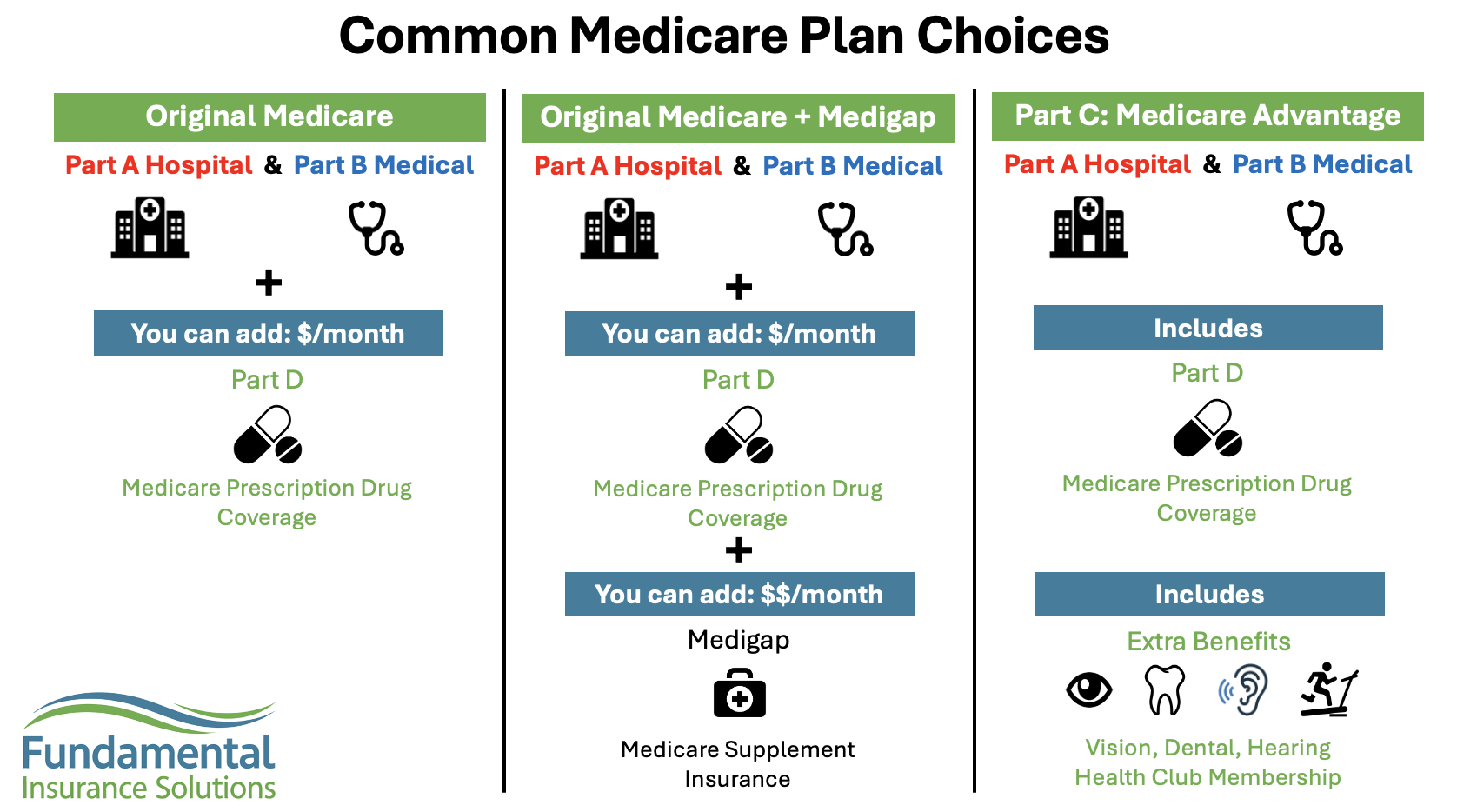
Private insurers offer coverages that will cover some of the cost associated with Part A & Part B, and even provide some benefits not covered under Original Medicare. Let's briefly explore your options:
Medigap (Medicare Supplement Insurance)
Medigap helps pay for the "gaps" in Original Medicare, such as copayments, coinsurance, and deductibles. These plans are sold by private insurance companies and are designed to work alongside Medicare Parts A and B. Medigap policies are standardized into lettered plans (e.g., Plan G, Plan N), and each offers a different combination of benefits. Some include coverage for foreign travel emergencies or skilled nursing facility coinsurance. These plans do not include prescription drug coverage.
Medigap provides predictable, stable medical costs for your healthcare needs. You must be enrolled in Medicare Part A and B to purchase, your exact cost depends on your age, location, gender, tobacco use, health and the specific lettered plan you choose. However, the benefits for each lettered plan are strictly standardized by law.
Medicare Part C (Medicare Advantage)
Medicare Advantage plans offer all the coverage provided by Original Medicare and usually goes a step further. Most Medicare Advantage plans include additional benefits that Original Medicare does not cover, such as prescription drug coverage, limited dental & vision services, hearing aids, wellness programs, and more. These plans may also include perks like gym memberships, telehealth services, and over-the-counter allowances.
- Coverage varies by insurer, so it's important to carefully review what's included. Medicare Advantage plans often operate as HMOs or PPOs, which means you may be required to use a network of doctors and hospitals.
- HMO: Health Maintenance Organization, is a type of health insurance plan that limits coverage to a specific network of doctors, hospitals, and providers. Generally lower copays/coinsurance for services and lower maximum out of pocket limits.
- PPO: Preferred Provider Organization, is a type of health insurance plan that gives you the freedom to see any doctor or specialist without a referral in/out of network. Generally higher copays/coinsurance for services and higher maximum out of pocket limits.
- You must be enrolled in Medicare Part A and B to be eligible for enrollment into a Medicare Advantage plan. Plan availability varies by your geographical location, and you cannot be denied coverage for any reason. Many plans have a $0 monthly premium, deductibles, copays/coinsurance can vary widely by plan. All plans have a set Maximum Out Of Pocket (MOOP), once reached in the plan year, you would pay zero for all services provided under the plan.
Medicare Part D (Prescription Drug Coverage)
Covers a wide range of prescription medications that beneficiaries need to manage chronic conditions, recover from illness, or maintain overall wellness. Each Part D plan has its own list of covered drugs, called a formulary, which includes multiple tiers of medications ranging from generics to specialty drugs.
- While all plans must meet basic federal requirements, the specific drugs covered, pricing, and pharmacy networks can vary significantly. Plans also include stages such as the deductible phase, initial coverage, and catastrophic coverage, which affect how much you pay throughout the year.
- Enrollment in a Medicare Part D plan requires you be eligible and enrolled in Medicare Part A and/or Medicare Part B. While enrollment in Part D is optional, delaying it without other creditable drug coverage may result in a late enrollment penalty for life.
How to Decide Which Plan Is Right for You
The right plan choice for you, depends on several factors; like your current health, finances, lifestyle and coverage priorities. This is where I come in, just complete the Medicare Review Request form, once received, I’ll do the research, set an appointment to present your options, make a recommendation and you make the final decision. It’s that simple.
Need Help Navigating Your Options?
Let's discuss your Medicare options and find a plan that works best for your health and budget.
Request a Free Consultation